
Your advisers are spending 41% of their week on tasks that don’t serve clients. Here’s what that’s actually costing you.
Most advice firm leaders know that admin takes up too much time. It’s a perennial gripe at conferences, in team meetings, and in every back-office review. But when you put real numbers to it, the scale of the problem becomes harder to ignore.
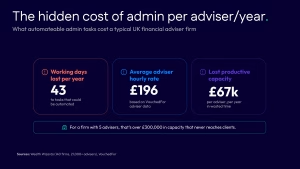
Recent industry research paints a stark picture. According to a survey by Wealth Wizards covering 140 firms and over 21,000 advisers, the average UK financial adviser loses 43 working days per year to tasks that could be automated. That’s not 43 days of complex, judgement-heavy work — it’s data rekeying, chasing paperwork, duplicating entries across systems, and manually reconciling information that should flow automatically.
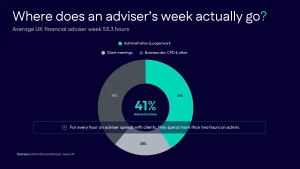
Meanwhile, research covered by International Adviser found that advisers spend 41% of their working week on administration — roughly 22 hours out of a 53-hour week. Only around 20% of their time is spent in client meetings. For firms that have invested heavily in platforms, CRM systems, and back-office technology, that ratio should give pause. The tools are there. The efficiency isn’t.
What does this cost in real terms?
Take the average adviser hourly rate of £196, as reported by VouchedFor. If each adviser is losing 43 days a year to automatable admin — call it roughly 344 hours — the maths is uncomfortable: that’s approximately £67,000 per adviser per year in lost productive capacity.
For a firm with five advisers, that’s over £330,000. Not in hard costs you’d see on a P&L, but in capacity that could have gone to serving clients, generating revenue, or simply giving your team breathing room.
And this isn’t a problem that fixes itself as you grow. In fact, it compounds. Every new adviser, every new client, every new regulatory requirement adds another layer of process. Without a deliberate effort to map and optimise how work actually flows through the business, firms end up scaling their inefficiencies alongside their revenue.
The real issue isn’t the technology — it’s the setup
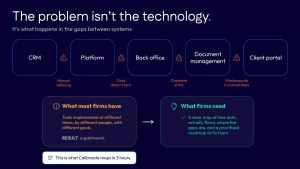
Most firms we speak to aren’t short on tools. They have a platform, a CRM, a document management system, perhaps a cash-flow modelling tool and a client portal. The challenge is that these systems were often implemented at different times, by different people, with different goals in mind. The result is a patchwork: data gets entered multiple times, integrations go underused, and workarounds become embedded in daily routines.
The problem isn’t visible in any single system. It lives in the gaps between them — in the manual steps that connect one process to the next. And because those steps have become habitual, they’re easy to overlook.
Finding the leaks
The first step is simply knowing where the time goes. Not in theory, but in the specific reality of your firm — your workflows, your team, your tech stack.
That’s exactly what we built Calibrate to do. It’s a free, structured 3-hour diagnostic for adviser firms. We sit down with your team, map your core workflows end-to-end, trace data flows across your systems, and identify exactly where time and capacity are leaking. You walk away with a prioritised roadmap of quick wins and longer-term improvements — no cost, no obligation.
As an approved intelliflo associate partner, we know the platform ecosystem inside out. But Calibrate isn’t about selling you more technology. It’s about making sure the technology you already have is actually working for you.
Is it worth three hours?
Consider the alternative: continuing to absorb £67,000 per adviser per year in lost capacity without knowing exactly where it’s going. Three hours to surface that picture feels like a reasonable trade.
If you’d like to find out where your firm’s time is really going, get in touch to book a Calibrate session.
Sources: Wealth Wizards adviser survey (140 firms, 21,000+ advisers); International Adviser; VouchedFor adviser hourly rate data; Aveni AI research on adviser time allocation.


